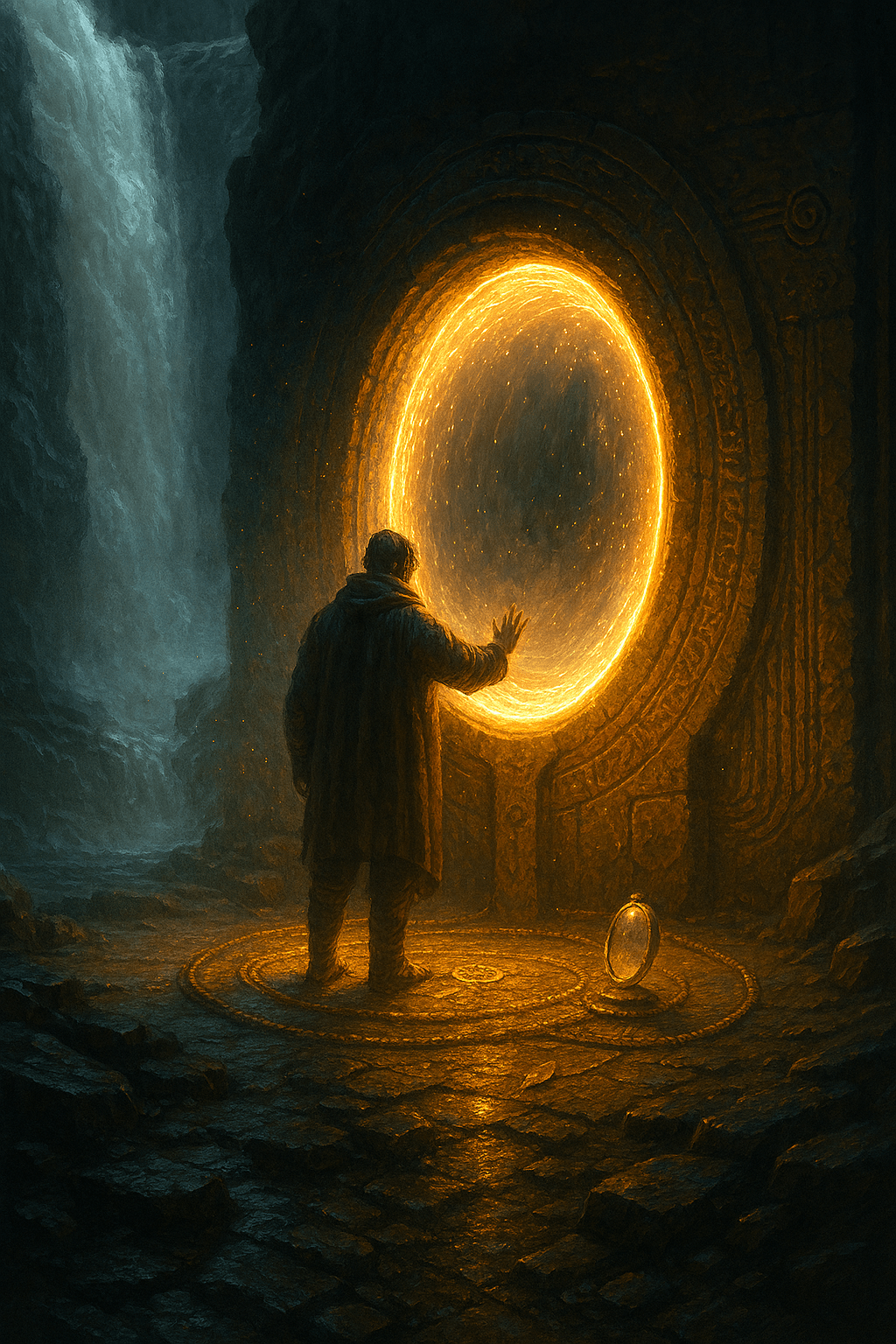
I’ll be stepping back from regular posting for a bit to focus on something that’s been quietly pulsing beneath the surface: turning the Blinkback story into book form. It’s time. The recursion, the memory fractures, the atmospheric bleed—it all deserves the depth and architecture of a proper book. And I’ve got a few other titles in the works too, each one layered with the kind of speculative grit and emotional resonance you’ve come to expect.
But I’m not disappearing entirely.
While the longer-form projects take shape, I’ll be returning to writing prompts here on WordPress. It’s a way to stay connected, keep the creative muscles warm, and maybe even test-drive some new motifs in real time.
Thanks for riding the waves with me. Your support means everything.
Parenthood is not the pursuit of control but the creation of space—a sacred paradox of love without desire.
Parenthood, like power, is a paradox wrapped in the human condition. Plato, in his wisdom, declared that the one most fit to hold power is the one who does not desire it. Such insight, profound in its simplicity, finds a quiet echo in the art of raising a child. For the heart that longs for completion through another, whether in leadership or parenthood, is a heart unwittingly tethered to illusion. Let us explore this delicate truth.
The Mirage of Fulfillment Through Another
The desire to become a parent often springs from the same well as our longing for love, success, or mastery—a thirst to mend the quiet fractures within us. We seek in the innocent gaze of a child the answer to our own incompleteness, imagining that their laughter might fill the hollow places. Yet, this longing, tender though it may seem, carries within it the seeds of discontent.
For what is this yearning but the echo of an inner void? What is this dream of parenthood but the hope that, through another, we might finally be whole? And herein lies the first great danger: to approach parenthood as a salve for the self is to misunderstand its nature entirely.
The Poison of Expectation
When a child is born into the arms of a parent seeking fulfillment, an unspoken contract is formed—one the child never consents to. They become a mirror, reflecting the hopes and unmet dreams of the parent. Expectations, invisible yet heavy, settle upon their small shoulders:
• To bring joy where there was sorrow.
• To succeed where the parent has faltered.
• To embody the values and desires the parent holds dear.
This silent burden grows with time, creating a chasm between the child and their own identity. Love, once thought to be unconditional, becomes tainted by subtle contingencies. And so, a dynamic emerges—not of nurturing, but of molding; not of liberation, but of quiet control.
The Mind Free of Desire
Yet, there is another path. It begins not with the child, but with the parent—more specifically, within the parent. To hold the role of a parent as one fit for it, the individual must first confront their own longing. They must stand before their inner emptiness and resist the urge to fill it with the fleeting balm of external attachments.
This is no small task. It requires courage, for the human heart resists stillness, preferring the noise of ambition and desire to the silence of self-reflection. But it is in this silence that the transformation begins. The parent who no longer seeks to complete themselves through their child is the parent who can truly see the child as they are: not a vessel, not a reflection, but a being unto themselves.
Power and Parenthood: A Sacred Paradox
Plato’s declaration—“He who does not desire power is fit to hold it”—unveils its deeper truth when applied to parenthood. The parent who does not seek fulfillment in the role, who does not hunger for the validation a child might bring, is the one most capable of wielding its responsibility with grace. This is the parent who nurtures without smothering, guides without dictating, and loves without condition.
To parent from such a place is to honor the sacred paradox: to hold power while relinquishing the desire for it. It is to step into the role not as an act of ego, but as an act of love—love unbound by the need to possess or control.
The Art of Wholeness
What, then, does it mean to prepare for parenthood in this way? It means turning inward before turning outward. It means asking the difficult questions:
• Can I find peace within myself, even in solitude?
• Can I witness my own emptiness without fleeing from it?
• Can I offer love without expecting it to heal me?
These are not questions to answer lightly, for they demand a reckoning with the deepest parts of the self. But the parent who can answer them with honesty, who has embraced their own wholeness, steps into parenthood not as a seeker, but as a giver.
A Closing Reflection
Parenthood is not a pursuit of completion, but a creation of space—a space where another life may unfold freely, untethered by the unfulfilled desires of its creator. To hold such space is the highest act of humility and the deepest expression of love. It is to embody the wisdom of Plato, not in the halls of power, but in the quiet, sacred art of raising a child.
James Elwood Burchfield Jr. passed away on April 30, 2021, at the age of 93. He lived a long life, filled with stories I’ll never get to hear firsthand, but it’s clear he made an impact on the world around him. He served in the Navy during World War II, retired from Wheeling Pittsburgh Steel, and was a proud Mason. Born in Steubenville, Ohio, in 1927, he saw decades of history unfold, and I can only imagine the stories he carried with him.
I didn’t grow up knowing my grandfather—or really, any of his side of the family. My father wasn’t part of my life, and while my stepdad did his best to fill that role, there’s always been a piece of me wondering about the other side of my roots. Reading his obituary, I realized just how much I missed out on—not just with him, but with an entire branch of my family tree.
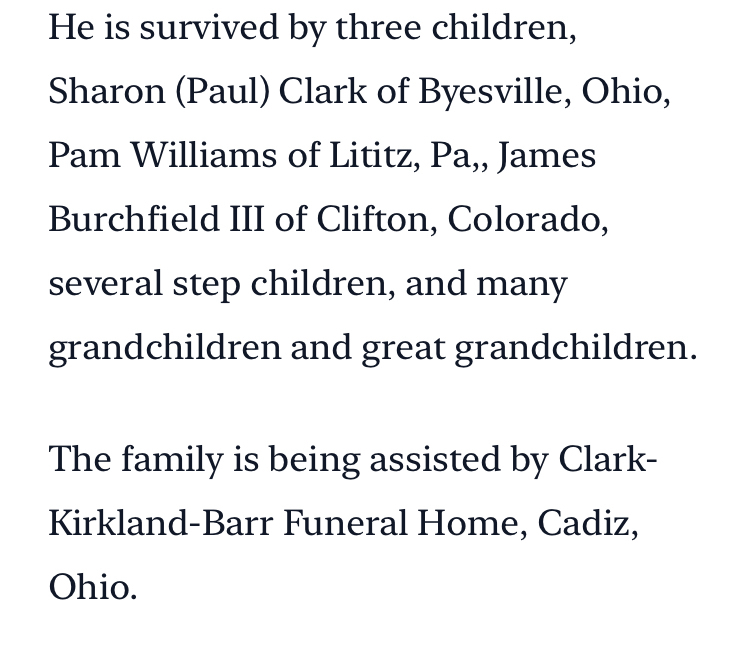
He was married three times, outliving his wives Shirley, Christina, and Zelda. He lost his siblings too—Mary Alice, Margaret, and William—but not before building a family legacy. He had three kids, Sharon, Pam, and James III, plus stepchildren, grandchildren, and great-grandchildren. A huge family, all connected through him. And yet, I’ve never met a single one of them.
Still, learning about him feels like uncovering a hidden chapter of my story. He loved simple joys: golfing, bowling, dancing, and playing euchre. Family gatherings and vacations at Guilford Lake were some of his happiest moments. I’ve been picturing those scenes—his laugh, the clink of euchre cards on the table, the sun setting over the lake. Even though I wasn’t there, it’s comforting to imagine the kind of person he might’ve been.
Would I want to meet the family I’ve never known? I think so. There’s a lot of history there, connections waiting to be rediscovered. Maybe someday, I’ll get the chance. Until then, I just wanted to write this as a small way to honor the grandfather I never got to know but whose story is, in some way, part of my own.


 Epic Alien Storytelling
You must be logged in to post a comment.