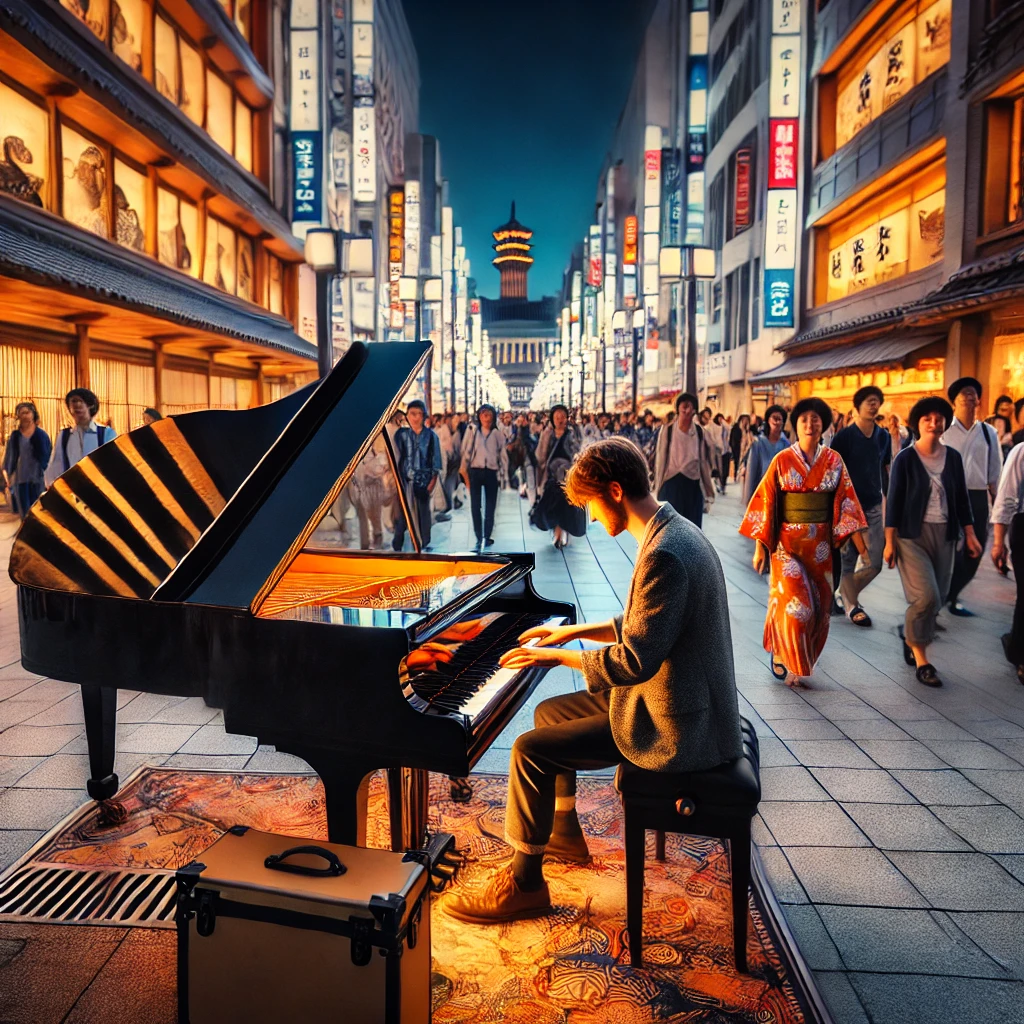
An Interview with Japanese Street Pianist Hirom Saito
The streets of Japan are alive with music, but among the sea of sound, there’s one pianist whose artistry transcends the ordinary. Meet Hirom Saito, a legendary street performer whose fingers dance across the keys, transforming everyday spaces into unforgettable experiences. From the bustling sidewalks of Yokohama to the serene melodies of his improvisations, Hirom’s music isn’t just heard—it’s felt. But what drives this modern-day maestro? What inspires his unique approach to spreading joy through sound? In this exclusive interview, we dive deep into the heart and mind of a pianist who’s changing lives one note at a time.
(While reading this piece please consider that the language barrier was crossed during this interview.)
Welcome to the world of Hirom Saito, where every performance is a gift of connection, creativity, and pure good vibes.
https://www.instagram.com/skydolphinhat1129/
1. Please tell us about your journey to becoming a street performer in Japan. How did it begin?
It all started in 2018 when an open street piano was placed in my neighborhood in Japan. Initially, this piano was set up temporarily at Shinagawa Station in Tokyo, and I was able to play it. Soon after, street pianos began to appear in other parts of Japan. This new phenomenon created an opportunity for me to perform in public and connect with people through music.
2. What attracted you to the piano, and why do you not lose the desire to play it every day?
I originally started playing piano in college as part of a jazz club, though I had played the synthesizer before that. The joy I find in playing the piano comes from its limitless possibilities and the sheer fun of creating music. That’s what keeps me coming back to it every day.
3. How is performing on the street different from performing in a traditional setting?
In a traditional setting, the audience is there specifically to listen to the music. On the street, it’s different. People are just passing by, and it’s a wonderful feeling to be able to catch their attention and lift their mood, even if just for a moment. Performing on the street feels more spontaneous and interactive.
4. What makes Japan a unique place to perform? How does its culture influence your music and performance?
Japan is a very safe country, and that makes it an ideal place for street performances. In some areas, it’s even possible to perform from early morning to midnight without any issues. This creates a unique opportunity to connect with people and reflect the culture’s appreciation for art and music.
5. What is your favorite place to perform in Japan, and why is it special to you?
My favorite places are Yokohama, especially Marinade Underground Mall and Bashamichi. These spots have a lot of history connected to street piano culture, and being able to perform there feels like being a part of that legacy. I also enjoy exploring different musical styles to keep performances fresh and interesting for myself and the audience.
6. Tell us about a memorable encounter you had with an audience during a performance.
There was a time when I didn’t have a piano at home, so I used to practice on the street every morning. One day, a TV crew approached me, interviewed me, and even aired my performance. That exposure eventually led to me forming a band.
7. How do you choose the songs you play? Are there any songs that resonate with people who stop to listen?
I tend to play my favorite music, including American, British, and Brazilian songs, as well as my own compositions and improvisations. Improvising music is particularly rewarding because it often surprises people and myself. I feel as though it speaks to the subconscious, creating a unique connection with listeners.
8. As a street performer, have you ever been in a particularly difficult situation? How did you overcome it?
There have been times when I’ve encountered drunk or rude people. On rare occasions, I’ve had to run away or seek help from the police. Luckily, those situations are not common.
9. What role does improvisation play in your performance? Do you create music spontaneously in response to your environment?
Improvisation is central to my music. It allows me to create something fresh and unique that connects deeply with the audience. When I improvise, I feel like the music flows through me, almost as if I’m listening to it alongside the audience. It’s a deeply rewarding experience that makes each performance special.
10. How do you feel your music connects with people on the street? Have you had any deeply moving interactions?
It’s incredibly gratifying when people stop to listen, applaud, or even share how the music has uplifted their day. Knowing that my music brings joy or comfort to others is one of the most fulfilling aspects of being a street performer.
11. Do you see any cultural or social differences in the way people react to street performances in Japan compared to other countries?
The reactions are generally similar across cultures. However, in Japan, street piano performances often focus on classical and J-pop music. I try to stand out by exploring other genres and introducing improvisational pieces to keep things fresh and unexpected.
12. Who are your musical inspirations, and how have they shaped your playing style and approach?
My inspiration often comes from conversations and interactions with people. Talking to those who stop to listen or reflecting on the energy of the moment inspires new ideas and approaches to my music.
13. What is a typical day as a street performer like? How do you prepare for a performance?
My day begins with strength training and drinking lemon water. Afterward, I practice piano for about an hour and a half before heading to my street piano spot. I record every session because you never know when something magical might happen.
14. Have you ever had a moment when you felt your music had a profound impact on someone’s life?
Yes, I often receive messages from people saying that my music has healed or energized them. It’s an indescribable feeling to know that my music has a positive impact on someone’s life.
15. What does the piano represent to you, and how would you like it to speak to others through your playing?
The piano, to me, is like a conversation from the subconscious. It expresses emotions and thoughts I’m often unaware of. I want my music to resonate with people’s hearts and souls, connecting them to something deeper within themselves. I’ve even thought about experimenting with frequencies like 436Hz to create an even more profound connection.
16. Do you ever collaborate with other street performers or artists in Japan? What were those experiences like?
Yes, I’ve had the opportunity to collaborate with musicians playing violin, harmonica, flute, vocals, and even full string quartets. These spontaneous sessions are always inspiring and push me to explore new ideas and approaches.
17. What is the most unusual or unexpected thing that happened to you while performing on the street?
One morning, while practicing, a TV crew came and interviewed me. They broadcasted my performance, which was a completely unexpected but wonderful opportunity.
18. How do you see your role as a street performer within the broader context of music and art?
I think of my role as a small but meaningful part of a larger butterfly effect. If my music brings even a moment of happiness or calm to someone, it might influence how they interact with others, how their day unfolds, and so on. I hope my music contributes to creating a happier and more peaceful world.
19. What advice would you give to someone who dreams of becoming a street performer or traveling musician?
Rather than offering advice, I’d say we should collaborate. I still have much to learn, and working together could inspire new ideas and approaches.
20. If you could play the piano anywhere in the world, where would it be?
I’d love to play inside a pyramid, underwater with dolphins, on Mars, in the Amazon jungle, on a world cruise, or even in a UFO.
21. What legacy or message do you want your music to leave behind for those who listen to it?
I want my music to bring positivity and lightness to people’s lives. I hope it inspires meaningful work, happy families, and peaceful homes. Knowing that I’ve contributed, even in a small way, to the happiness of the planet would be the greatest legacy.
Thank you, Hirom Saito, for sharing your story and insights. Your passion and dedication to music are truly inspiring.
Take a moment to enjoy Hirom Saitou’s music available in the links below:
● 3rd album
https://audiostock.jp/artists/45937/albums/8280
● 2nd album
https://audiostock.jp/artists/45937/albums/5294
● mini album
https://audiostock.jp/artists/45937/albums/5354
● 1st album
https://audiostock.jp/artists/45937/albums/3513
● thread
https://www.threads.net/@skydolphinhat1129
● tiktok
https://www.tiktok.com/@hiromjam
● X
https://twitter.com/meowhirom?ref_src=twsrc%5Egoogle%7Ctwcamp%5Eserp%7Ctwgr%5Eauthor
Closing Thoughts
Hirom Saito’s music is more than melody; it’s a gentle ripple of connection, a momentary pause in the whirlwind of life, and a heartfelt offering of joy to all who cross his path. His approach to sharing good vibes is both disarmingly simple and profoundly impactful—a testament to the quiet power of music to transform the mundane into the extraordinary.
What sets Hirom apart is not just his talent, but his intentionality. Each note carries the weight of his desire to heal, to inspire, and to connect. His improvisations, born of pure spontaneity and shaped by the energy of his surroundings, feel like fleeting conversations with the soul—both his and ours.
There’s a quiet poetry in his belief that music, when shared openly, can trigger a butterfly effect of positivity. A passerby, carried by the warmth of his sound, might approach their day with renewed energy and spread that light in ways unseen. In this way, Hirom’s artistry transcends the keys of the piano, embedding itself in the rhythm of life.
Hirom Saito’s journey as a street performer reminds us of the beauty in giving unconditionally, of finding joy in the shared experience, and of embracing music as a universal language that binds us together. Through his playing, he invites us to pause, to feel, and to be present—and in doing so, he leaves the world just a little brighter, one performance at a time.
締めの言葉
齋藤ヒロムの音楽は、単なるメロディではありません。それは、人生の喧騒の中でそっと広がるつながりの波紋であり、一瞬の静寂であり、彼と交差するすべての人々に向けた心からの喜びの贈り物です。彼が良い雰囲気を共有する方法は、驚くほどシンプルでありながら深く影響を与えるものであり、日常を特別なものへと変える音楽の静かな力を証明しています。
ヒロムを際立たせるのは、彼の才能だけではなく、その意図性です。一つ一つの音には、癒し、感動、そしてつながりを生み出したいという彼の思いが込められています。純粋な即興から生まれ、その場のエネルギーに形作られた彼の演奏は、彼自身と私たちの魂との一瞬の対話のように感じられます。
音楽がオープンに共有されることで、ポジティブな影響の連鎖を引き起こせるという彼の信念には、静かな詩情があります。彼の音の温かさに心を動かされた通行人は、日々に新たな活力を見出し、その光を見えない形で広げるかもしれません。このようにして、ヒロムの芸術性はピアノの鍵盤を超えて、人生のリズムそのものに溶け込んでいくのです。
ストリートパフォーマーとしての齋藤ヒロムの旅は、無条件に与えることの美しさ、共有体験に喜びを見出すこと、そして音楽を私たちを結びつける普遍的な言語として受け入れることを私たちに思い出させてくれます。彼の演奏を通じて、彼は私たちに立ち止まり、感じ、そして「今」を生きるよう招いてくれます。そしてそのたびに、世界をほんの少し明るく照らしてくれるのです。
Read my latest work at the link below:
 Epic Alien Storytelling